Hallux valgus surgery is one of the most frequently performed procedures at Dworska hospital® in Cracow (Poland). Each patient is individually qualified for the appropriate corrective method. Thanks to this, we maximize the chances of obtaining good permanent outcomes:
- elimination of the bunion pain,
- straightening the big toe,
- narrowing the forefoot,
- the patient can return to wear standard-width shoes.
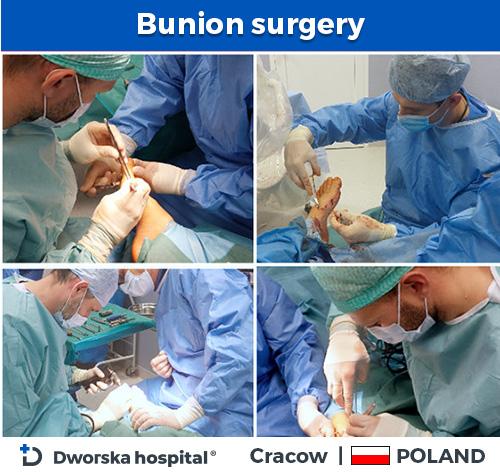
Read the article below to learn more about the surgical methods for hallux valgus deformity, indications for the procedure and recovery after the operation according to the knowledge of our foot surgeons.
Make an appointment with a surgeon operating bunions at our hospital
[title]
[image-intro]
[readmore text="Read more"]{/article}
[title]
[image-intro]
[readmore text="Read more"]{/article}
[title]
[image-intro]
[readmore text="Read more"]{/article}
What is bunion surgery?
So far, over 100 surgical methods have been developed to correct hallux valgus. Most of them hold historical significance now. At Dworska hospital®, our orthopaedists perform bunion surgeries using proven and modern methods, such as:
- chevron,
- chevron-Akin,
- scarf,
- scarf-Akin,
- MICA, MIC-PTSA,
- Lapidus,
- arthrodesis of the first metatarsophalangeal (MTP) joint.
These procedures can be conducted either from the open approach (through larger skin incision) or can be minimally invasive (performded through small point skin incisions or percutaneously). The selection of the appropriate surgical method is always proceded by a detailed diagnosis and qualification process.
To permanently correct hallux valgus, it is most often necessary to perform an osteotomy (cutting) of the first metatarsal bone. Below we present a 3D animation of the chevron method according to the preferences of Grzegorz Jarosławski, MD:
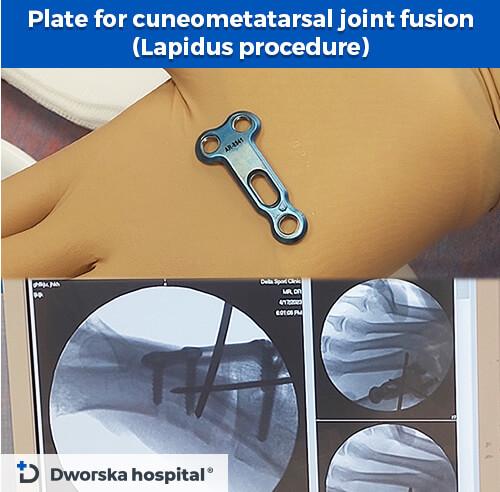
In more advanced deformities or hypermobility, a corrective fusion of the first cuneometatarsal joint may be necessary (it's called the Lapidus method).
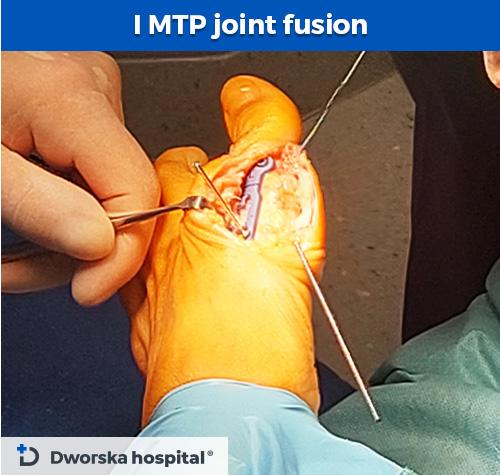
In the presence of degenerative changes in I MTP, a fusion (an arthrodesis) of the I MTP is considered the most suitable treatment method.
Bunion correction in Poland - what is the qualification for the procedure?
What are the indications for bunion surgery?
Indications for hallux valgus surgery include foot pain caused by hallux valgus deformation:
- pain on the medial side of the bunion,
- pain in the deformed first metatarsophalangeal joint,
- foot pain that makes it difficult to walk or wear shoes of commonly available width,
- pain at the bottom of the forefoot (under the second and third metatarsal heads) related to the transfer metatarsalgia caused by the first metatarsal elevation.
Selection of the surgical method
The selection of the appropriate bunion surgery method may depend on:
- the degree of deformation assessed on the weight-bearing foot X-rays,
- detection of possible hypermobility in the first cuneometatarsal joint,
- the presence of possible degenerative changes in the first metatarsophalangeal and the first cuneometatarsal joint,
- the patient's activity level,
- concomitant diseases that the patient suffers from (e.g. rheumatoid arthritis).
In some cases, the surgeon may detect accompanying structural deformities of the foot or other pathologies that need to be operated at the same time (e.g. claw toes, bunionette, flatfoot).
Preparation for surgery - foot examination and medical tests
To qualify for the procedure, please bring weight-bearing X-rays of both feet (AP + side views) taken recently.
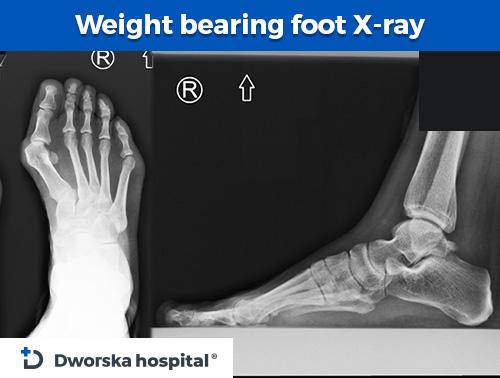
After orthopaedic qualification for the procedure, the patient receives recommendations regarding the medical tests for anaesthetic qualification -> go to the "preparation for surgery" tab.
Recovery after hallux valgus surgery
After the procedure, a special dressing is placed on the foot to protect the wounds and safely secure the position of the operated toe.
The operated foot should not be bathed until the stitches are removed and the wounds are fully healed. To take a shower, put a waterproof bag on your foot. The stitches are removed approximately 10-12 days after the procedure.
Walking after hallux valgus surgery is possible with the Barouk shoe or another shoe orthosis with a hard and rocker-shaped sole. The recommended type of orthosis is provided by the surgeon during the qualifying visit for the procedure.
Pain after bunion surgery results from the bone healing after corrective osteotomy, as well as the healing of the adjacent soft tissues.
Pain relief can be achieved by elevating the foot above hip level and applying cold packs. Besides, you may need to take painkillers prescribed by your surgeon.
Rehabilitation after surgical treatment of hallux valgus
Rehabilitation after bunion surgery is aimed at:
- reduction of postoperative pain and swelling,
- restoring the range of motion in the metatarsophalangeal joint (apart from the arthrodesis),
- learning how to properly load the foot during walking, gait re-education,
- learning movement patterns safe for the operated part of the foot.
Physiotherapy is conducted in a well-equipped gym on-site at our hospital. Meet our team of physiotjerapists.
Can the effects of hallux valgus surgery be considered permanent?
If the surgeon has selected an appropriate surgical method for the foot, and the patient strictly follows the postoperative recommendations, the correction effects should be permanent.
On the other hand, it's worth mentioning, that the patient must not wear narrow shoes or high heels frequently, because this could lead to a recurrence of the bunion regardless of the surgery results.
It should be emphasized that surgical treatment is the only method of permanent correction confirmed by research. Foot orthotics serve to relieve pain and improve the elasticity of contracted soft tissues, but they are not able to permanently change the position of the first metatarsal bone.
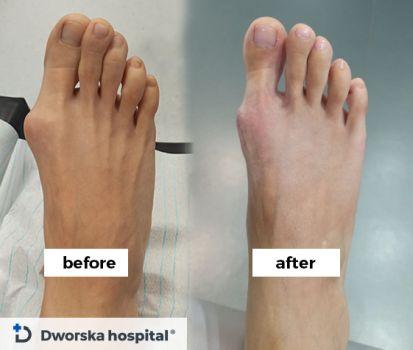
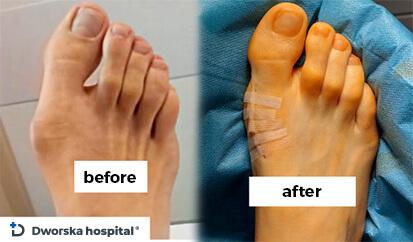
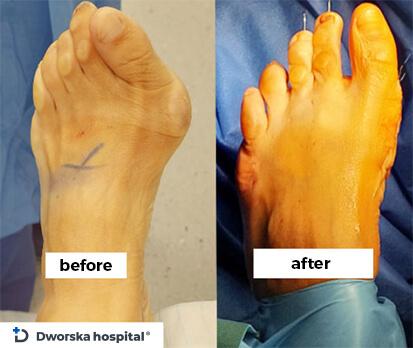
The outcomes of bunion surgery
Note: The effects of the bunion surgery may vary depending on the advancement and complexity of the foot deformity, as well as other individual health conditions of the patient. In each case, before treatment, the patient requires an individual orthopedic consultation.
Revision surgeries for failed hallux valgus correction
If the patient has undergone bunion correction surgery in another hospital and the deformation has returned, we encourage you to consult one of our experienced foot and ankle surgeons.
Our specialists perform revision procedures with the removal of screws or a plate. Next, the orthopaedists may perform either a corrective osteotomy again or a fusion (arthrodesis). These methods allow for permanent correction and improvement of the foot shape.
What factors determine the cost of bunion surgery?
The cost of surgery depends mainly on:
- selected surgical method,
- the cost of plates and/or screws stabilizing the bones,
- the need to stay overnight in the hospital (accommodation fee if the procedure is performed in the afternoon or evening).
The surgeon's experience in performing this type of procedure may also influence the price of bunion surgery.
Unlike other hospitals, the cost of the procedure performed at Dworska hospital® in Poland includes:
- anesthesiological qualification,
- anaesthesia,
- perioperative care,
- additional medical tests performed at our hospital,
- nutrition,
- medicines,
- foot dressing.
Important information
| Duration of the procedure (depending on the method) | 30- 60 minutes |
| Medical tests required for anaesthetic qualification | basic - go to the preparation for surgery tab |
| Anaesthesia | spinal anaesthesia, general anaesthesia or local nerve blocks |
| Hospital stay | minimum 2 - 6 hours after surgery |
| Period of significant dysfunction (walking using orthopaedic shoe AND assistance with crutches) | 2 - 3 weeks after the procedure |
| Period of limited dysfunction (walking using an orthopaedic shoe) | 4 - 6 weeks after the procedure |
| Removal of stitches - first visit | 10-14 days after the procedure |
| Change of dressings | every 3-4 days |
| Contraindications to the procedure | individual |
Frequently asked questions about treatment for hallux valgus:
To prevent the development of bunions, it is recommended to regularly strengthen the foot muscles, stretch the calves, wear comfortable footwear with wide toe boxes, maintain a healthy body weight, and avoid prolonged periods of standing. It's important to keep in mind that factors such as genetic conditions, rheumatoid arthritis, and diabetes can contribute to the development of hallux valgus, so it's not always possible to completely prevent bunions. However, we can take steps to slow down the progression of the deformity. People who are more susceptible to bunions should undergo regular foot examinations to detect the condition in its early stages.
Bunion surgery is the only effective way to permanently correct deformation. It makes it possible to reduce the width of the foot and straighten the big toe, thanks to which the desired cosmetic effect and reduction of pain are obtained after the treatment. Conservative treatment, i.e. wearing haluksy braces or orthopedic insoles, may alleviate symptoms, but does not reduce deformities.
Orthopaedists advise undergoing a surgical procedure for hallux valgus when it becomes difficult to wear normal shoes comfortably due to the size of the painful bunion, and when the pain is severe enough to significantly affect the quality of life. The physician should have a comprehensive conversation with the patient regarding the expected outcomes of the surgery, taking into account the patient's expectations.
The length of convalescence after the bunion treatment depends on the initial degree of deformation and the extent of the treatment. Full recovery in most cases is possible in the third month after the procedure. An important role is played by the patient's involvement in rehabilitation, which significantly speeds up the recovery process after surgery.
After your surgery, you will need to wear a specialized orthosis called a Barouk shoe to help relieve pressure on your operated forefoot. It will take approximately 6 weeks for the bones to fuse properly before you can begin walking in normal shoes again.
A well-planned and carefully performed bunion surgery brings lasting results. If the patient follows the specific recommendations of the orthopedist and physical therapist, there is no possibility of the hallux recurrence. Wearing high-heeled shoes or shoes with narrow toes is contraindicated as, regardless of the result of the operation, it may cause the big toe to curvature again.